
You just invested in a new garage floor coating. Maybe it was a quick 1-day install, or a DIY project you were proud of. Either way, it looks clean, smooth, and finished. But the first time you park your car, damage can begin almost immediately if the system is not built to handle it. Hot tire transfer is one of the most common reasons coatings fail early. A professionally installed polyaspartic floor coating is designed to prevent that from happening.
What Your Tires Leave Behind Without You Realizing It
Many 1-day garage floor coatings rely on less-than-100%-solids, quick-cure polyurea or polyaspartic coatings as both the direct-to-concrete primer coat and single clear top coat. Polyurea-polyaspartics are a poor choice as the direct-to-concrete primer because they only go down thinly (i.e., they’re not high-build coatings) and cure so quickly that they fail to deeply penetrate the concrete slab. The thin, poorly-penetrating primer is thus susceptible to moisture pushing up through the porous concrete.
Conversely, polyurea-polyaspartics can make for excellent clear top coats! If, that is, they are quality 100%-solids and provide high cross-linking. If not, their use as clear top coats can also be problematic.
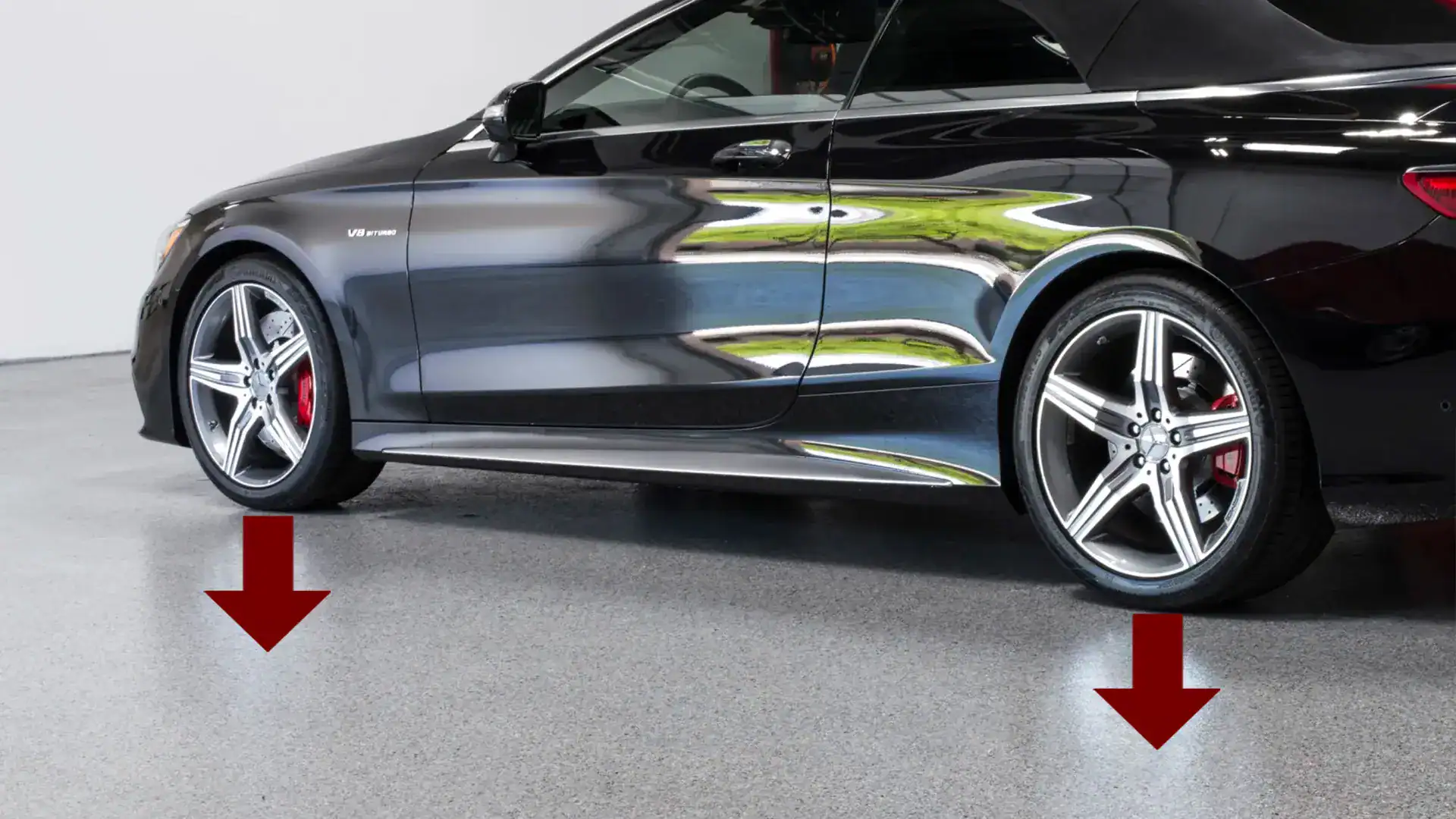
Why? Car tires contain plasticizers that keep the tire rubber flexible. But as tires heat up during driving, these compounds migrate to the tire’s surface. Once you park, those plasticizers can transfer into poorer quality polyaspartic top coats over time, causing discoloration, a sticky surface, and eventually coating breakdown. (Which is why many “1-day” installers don’t warrant against hot-tire transfer).
Hot tire transfer is not just a surface issue. It is often the first sign the system is failing.
Why a 2-Day Polyaspartic Floor Coating System Holds Up
At Garage Floor Coating of Ohio, we install a “hybrid” 2-day coating system that employs a moisture-mitigating epoxy as primer and quality polyaspartic.
Day one begins with mechanical grinding to properly prepare the concrete. Then, a high-build, moisture-mitigating, 100%-solids epoxy base coat is applied and a full flake broadcast is embedded into this base layer for strength and texture. The epoxy is allowed to cure overnight for deep concrete penetration.
On Day 2, two separate, highly-cross-linked, 100%-solids polyaspartic topcoats are applied, creating a dense, protective surface that resists heat, pressure, chemical exposure…and hot-tire transfer!
Built for Midwest Wear and Tear
A high-quality polyaspartic coating creates a UV-stable barrier that prevents hot tire pickup and stands up to seasonal temperature swings.
From hot summers to cold winters, your garage floor needs a system that will not break down under stress.
Before you park your car, make sure your floor is built to last.
Contact Garage Floor Coating of Ohio today to learn more about a polyaspartic floor coating system that stops hot tire transfer before it starts.